The tiny green buds sprouting today all over what only yesterday were brown sad dessicated trees.
The color of sunlight bursting through the decreasing patches of muddy brown as the radiant and well-named Gold Finches shed their drab winter coat.
The cream-and-yolk-yellow daffodils, with their Wordsworth-giddy heads erupting from their tall green stalks, like daytime fireworks.
The birds singing with operatic gusto, as if they hadn't had the chance to exercise their vocal cords in a long long time.
The dogs walking with their goofy faces in full display, wacky grins spread wide, tongues hanging out, and fish-eyes bulging, anticipating all they will discover in their daily detective work.
The opened windows, inviting the cool breeze that ushers out the stale smells of a house closed onto itself too long and delivers the perfume of life emerging, unstoppable and new.
The spring peepers, Ohio cousins of the diminutive too-cute-to-be-true coquí, rehearsing their hymns, like the devoted chorus of an outdoor church.
My husband and I, sitting outside in our small deck until the light is too low to read and the mosquitoes (the truest, if least appealing, sign of spring) are out for blood.
How not to love the spring when it arrives so willingly, with such self-confidence and desire to please?
Wednesday, March 28, 2007

Monday, March 26, 2007
Second chances
Yesterday, I turned five years old. And while you may think I'm speaking metaphorically, I'm actually being quite literal.
Five years ago yesterday I had the life-saving surgery that altered the course of my history after 15 years of wrestling with a disease that wouldn't let go and almost killed me. My father often reminds me of how I cheated death, and I know he's entirely right about that. That's why I never call her name in vain, no vaya a ser that she's hanging around these parts and remembers I'm one of the ones she didn't get when she intended.
I also know how truly Dracula speaks when he tells Jonathan Harker that there are worse things than death.
That's why, in this second chance at life I was given, I pay attention to and relish almost every minute I am given to breathe without pain and to shine with the fulgor of a faraway star that burns brightly against the cielo of my soul.
Long-time journalist Leroy Severs has a blog on NPR (and a weekly podcast) titled My Cancer in which he shares his on-going struggle to beat "the monster," as he calls it. I heard one of his recent podcasts in which he said that you can't go through a life-altering disease, like cancer, without leaving your old life behind and creating a new one, with brand-new attitudes and expectations.
I used to believe that was true, since that certainly has been my case, although my disease wasn't cancer. But I unfortunately know people who've gone through terrible illnesses and have not changed their old ways and have failed to learn much about how seismic a change a chronic and possibly recurring disease (as mine also is) should be.
Grappling with and succeeding against illness (even if momentarily) is life's way of giving us a chance to learn to "suck the marrow," or chuparse el hueso, as we'd say back home, of every day you get that's not marred by overwhelming pain and suffering. (BTW, I thought the phrase in English was my own translation of our saying related to sucking the very last bits of a juicy pork chop, but I actually found it sometime ago in reading Thoreau!).
I am blessed because I learned the lesson. Every day for me is a gift from God and I try to treat it with the reverence it deserves.
No longer will days fly by me, unnoticed and untraveled, because I'm in too much of a hurry to be or to do or to get or to please. No longer will days conclude without my feeling I have lived them to the fullest I could within each day's list of possibilities and challenges.
Five years ago yesterday, the Heavens saw it fit to give me, a wretched mortal, a second chance at living a better life. By God, I renew my pledge each day, such a second chance cannot and shall not be wasted.
Saturday, March 24, 2007
Los Nuyores
I can understand why Puerto Ricans migrating to New York City called this place Los Nuyores, in plural. The city is so vast and so majestic that only a plural rightly describes its scope and its feel.
In many ways, New York feels like another kind of "home" to me. When we were children, we visited often and we would walk all over the city, whose grid-like layout - so much more logical than Boston's cow-ploughed streets - I never did learn.
But I did learn to fully appreciate its city-ness, its buildings that reach for the blue sky and the sun that streams unevenly through the corridors of avenues and streets, illuminating some structures while keeping others in shadow. It was here that I learned to love the faraway sound of horns honking and police officers whistling and emergency vehicles wailing in the distance. Those sounds, oddly enough, mean "home" to me.
When my husband and I first moved to the Ohio suburbs, I had trouble acclimating to the utter silence of the nights. When a few years ago we moved to a small city near the capital, I knew it was a good decision for many reasons, but one of them included that I could hear the distant roar of the cars sailing through the expressway and the faint wail of the sirens in the nighttime. Those, to me, are the sounds of the city.
This morning, my "tree" friend and I took a nice walk on a sunny cool spring day on Fifth Avenue to Rockefeller Center and back to where we're staying. I was a little kid again, pointing at the Cathedral and ooing and aahing over every interesting thing I saw on the way. I probably annoyed my very patient and kind friend but she didn't let on at all.
I wanted to kick myself for failing to listen to the sage advice of Dr. S, who said I should bring my little digital camera with me to NYC. I didn't and I regret it because there's thousands of pictures that went untaken even if they remain in my mind's eye as vivid prints of the city's uniqueness. The next time the camera comes with me, for sure.
Last night, I had dinner at Sueños in Chelsea - which I highly recommend since the food was exquisite - with another group of women friends (some brand new to that evening). Although the night concluded with the unexpected illness of one of the new fascinating women I had met, up until that moment we were all delighting in the company of smart, hardworking women with lots of interesting things to say and share.
Tomorrow, it's back home to Ohio. But for today, I'm drinking in Los Nuyores like there was no tomorrow.
Tuesday, March 20, 2007
La puerta y el altar

This gated foyer in Viejo San Juan, with its bright green walls, white wood door and black rejas, boasts a little altar to the Virgin Mary with a tile rendition, a carved santo and a large white candle.
A site of private prayers made public to catch the eye and hearts of passers-by.
Making bread
For the first time in weeks, I'm sitting here with nothing pressing to do (well, except for making bread for my husband) and I'm relishing the moment.
There's been so many things pending in the past few months that it seems like I've always had something in the back of my mind that had to be completed or accomplished or read or written or sent or received. Not that there aren't things that need to get done anymore, but the bulk of what was up in the air is now settled on firm ground and now it's all a matter of waiting (something I'm not particularly good at, but oh well).
For a few minutes longer, I'm going to sit here and enjoy that feeling of not having to make sure something gets done before I go downstairs, plug in the bread maker (I used to be a purist and kneaded my bread but the bread maker is so much faster), and have a warm and nice-smelling loaf of bread ready in a hour.
My husband is a bread-ophile so there's always bread in the house, whether made by me or store bought. Personally, there's no bread I love more than a piece of the crusty steaming Pan de Pepín baguette I buy every time I visit Puerto Rico. I know my own bread isn't even remotely that good, but it will do.
I really like making bread (even if I don't get to knead it) because there's something primordial, primeval and human about it. I feel connected to the women of centuries before me who made bread and to those who still make bread today.
And there's something about bread and about my Catholic background that invests the bread-making and bread-having with a symbolic meaning that makes it significant and weighty. I feel so pleased and proud every time the yeast comes alive, as it should, and the bread rises and hardens and browns to perfection.
My bread is simple but solid and nourishing and its warmth and freshness is a welcome respite from overly processed and additive-laden alternatives. It's not artisanal or fancy or special, but it will do.
Even though my bread is a "fast bread," according to the bread maker's setting, it's not rushed and it doesn't skip any steps. I'm thinking bread is the perfect segue back into the routine of life after pausing for a long-in-coming and surprising moment of nothing-to-do-ness.
Saturday, March 17, 2007
Galería de fotos
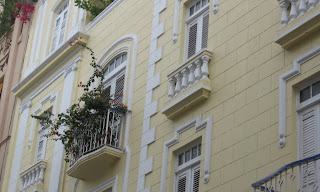
If you go to Viejo San Juan, pay special attention to the balconies. They're often a sight for sore eyes.

The windows are pretty cool, too.

As are the doors, with their beautifully crafted rejas and the tiles on the stairwells and floors.

This is the door to one very small and very rectangular casita in Viejo San Juan.
 This is a painting of Don Pedro Albizu Campos, the Nationalist Party leader who spent most of his life behind bars where he was finally secretly radiated to death.

The blue cobblestones in the Old City are gorgeous. José Campeche has a painting that shows when they were first laid down in the eighteenth century.

A view of El Morro, San Juan's fortress and erstwhile prison with its signature garitas. It is said the chilly dungeons are haunted...


The Iglesia de San José, bombarded by the Americans in May 1898, is being restored to its former glory. I used to attend Sunday services at the church many years ago.

The delicate and flashy trinitarias are my very favorite Caribbean flower.

The windows are pretty cool, too.

As are the doors, with their beautifully crafted rejas and the tiles on the stairwells and floors.

This is the door to one very small and very rectangular casita in Viejo San Juan.
This is a painting of Don Pedro Albizu Campos, the Nationalist Party leader who spent most of his life behind bars where he was finally secretly radiated to death.The blue cobblestones in the Old City are gorgeous. José Campeche has a painting that shows when they were first laid down in the eighteenth century.

A view of El Morro, San Juan's fortress and erstwhile prison with its signature garitas. It is said the chilly dungeons are haunted...
At least the spirits resting in the National Cemetery have a great view of the azure Atlantic.
The Iglesia de San José, bombarded by the Americans in May 1898, is being restored to its former glory. I used to attend Sunday services at the church many years ago.

The delicate and flashy trinitarias are my very favorite Caribbean flower.


Puerto Rican fruits and vegetables in the middle of the busy city of Hato Rey.
Friday, March 16, 2007
An embarassment of robins
Well, not quite. But this morning, as I resumed my early walks with the dogs, I counted at least six robins happily pecking at the thawed and sprouting ground.
The dogs were in their element, doing their usual sniffing and pulling and grunting and marking (Geni has taken to imitating Rusty and trying to lift one of her hind legs to pee, which considering her girth is a pretty humorous scene to witness). And I was in my element despite that fact that, in crossing the Atlantic, I returned to be in about 40 degrees less of warmth and sunshine than when I was in Puerto Rico.
But, for me, the best part of traveling is returning to my own home and to my daily routines. At heart, I'm not much of a traveler although I've come to appreciate the quiet and focused time afforded by airplanes for reading.
In fact, I pretty much hate traveling not because I'm afraid of flying but because I dislike the whole process of getting in and out and of being on airplanes. I wish we had advanced to Star Trek levels of technologies where I could just use a transponder (or whatever that thing was called) and yell: "Beam me to [wherever I'm going], Scottie!"
It's possible, I've considered, that the pretty amazing amounts of traveling we did as kids has contributed to my otherwise inexplicable general antipathy for traveling. Before I turned 16, I had been to the former U.S.S.R. (where we ate and drank every possible concoction imaginable made of apples and where the sun was out for about four hours in winter), to Colombia and Venezuela, to Mexico, to Paris and London, and to Greece and Egypt, in addition to many trips to the States.
In their efforts to combat the increasing materialism bred by an Americanized Christmas in Puerto Rico (after we'd started asking for toys by brand names), my parents decreed when I was about 10 years old that we'd spend the holidays in December traveling so we could experience the world. They pooled their middle-class earnings and we mostly went on the cheapest educational tours they could find.
The trip to London was particularly memorable because they played the Abba song "Fernando," over and over in the restaurant. To this day, we can all recite the song verbatim. We arrived during the Boxing Day holidays when nothing was open and there were no cabs. We walked for miles around the entire city and ate in a fish-and-chips place owned by Indians, but we didn't get to tour Buckingham Palace, the Tower of London, or any of the other famous tourist attractions everyone talks about when they've been there. My next trip to London, whenever that might be, will be a quite the pleasant surprise since all I remember is Madam Tussaud's wax museum (which was great fun) and Shakespeare's town (where I had the best butter bread ever!).
I guess all that world traveling at an early age contributed to making me quite a committed homebody, to my wanderlust husband's continual dismay. Of course I enjoy traveling to be with my loved ones and to visit (some) new places. But, in the end, I'm happy to be back home so that I can take long walk with my old doggies and start looking out for Mr. Robin once more.
Subscribe to:
Posts (Atom)